
On Monday morning November 11th 2013, Atlantans were greeted by the news that the Braves, Atlanta's iconic baseball team, will leave Turner Field when their lease ends in 2016 and will move into a new stadium in Cobb County in time for the 2017 season. The announcement left many questions in its wake and social media and news outlets quickly became a cornucopia of commentary ranging from jubilant acceptance to vitriolic criticism.
But as the day and week wore on, and as the shock that followed Braves President John Schuerholz's press conference wore off, it became evident that the club's decision will have a much broader impact on the city which goes beyond the zip code the team will call home.
To their credit, the Braves PR team launched a new website, www.homeofthebraves.com, to provide a central place where fans and interested parties can go to get the organizations stance on the matter. The website is comprehensive and does an excellent job answering why they think moving is a great idea. As Max Blau of Creative Loafing puts it, the website "sums [the Braves’] rationale up in one paragraph:"
Therefore the answer to the Brave's predicament, the website argues, is to move closer to the geographic center of the team's fan base. Their evidence: a map showing ticket sales for the 2102 season that paints Atlanta’s north suburbs in a sea of red, clearly delineating the heart of Braves Country.
Shortly thereafter, politicians and special interests began quibbling over key concerns. Is the move truly a “done deal?” Can Braves be enticed to stay Downtown? Are the Braves and the city betraying a promise of revitalization made to the folks living in the neighborhoods around Turner Field, a promise that has yet to materialize? How much will Cobb taxpayers be on the hook with this move? But, one common concern seems to haunt the minds of Atlantans regardless of the positions they take. Traffic.
It is no secret that traffic on the Northside Perimeter is a nightmare on a good day, especially near where Interstates 75 and 285 meet, the very same area where the proposed stadium is to be built. So, what happens to everyone’s commute when you build at its crux a 60-acre mixed-used development with a 42,000-seat stadium as it’s main attraction?
To their credit, the Braves PR team launched a new website, www.homeofthebraves.com, to provide a central place where fans and interested parties can go to get the organizations stance on the matter. The website is comprehensive and does an excellent job answering why they think moving is a great idea. As Max Blau of Creative Loafing puts it, the website "sums [the Braves’] rationale up in one paragraph:"
The reason for moving is simple. The current location has certain issues that are insurmountable and will only become more problematic over the years. These fundamental issues involve how you, our fans, access Turner Field. There is a lack of consistent mass transportation, a lack of sufficient parking and a lack of direct access to interstates. Furthermore, the Braves do not have control over the development of our immediate surroundings[1][2].
Therefore the answer to the Brave's predicament, the website argues, is to move closer to the geographic center of the team's fan base. Their evidence: a map showing ticket sales for the 2102 season that paints Atlanta’s north suburbs in a sea of red, clearly delineating the heart of Braves Country.
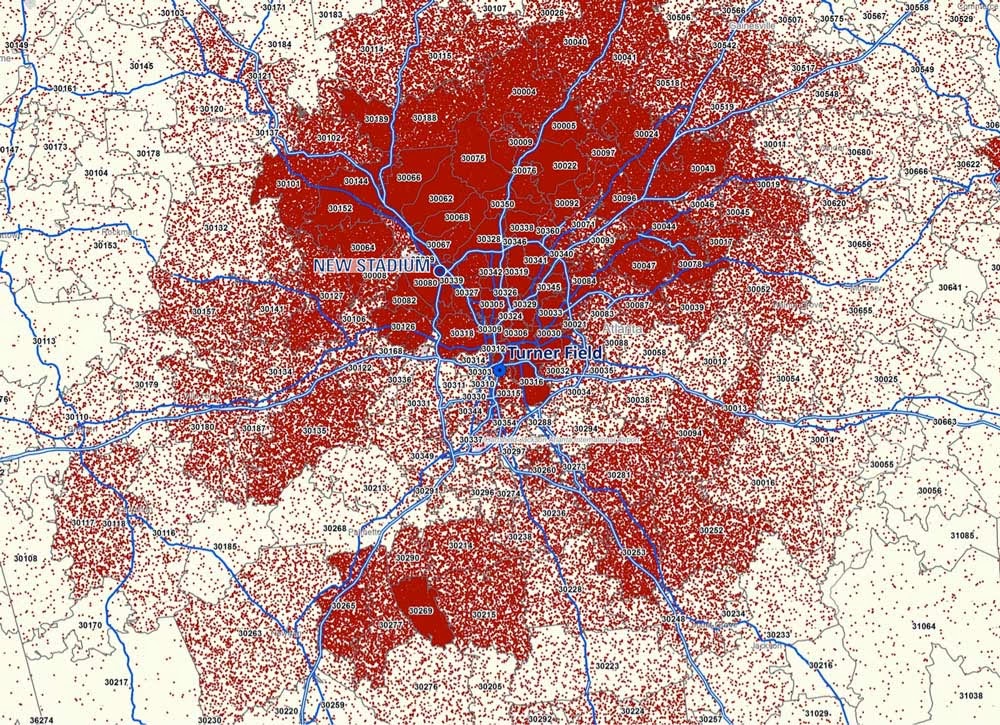 |
| Last Season's Ticket Sales [Image Source: HomeOfTheBraves.com] |
Shortly thereafter, politicians and special interests began quibbling over key concerns. Is the move truly a “done deal?” Can Braves be enticed to stay Downtown? Are the Braves and the city betraying a promise of revitalization made to the folks living in the neighborhoods around Turner Field, a promise that has yet to materialize? How much will Cobb taxpayers be on the hook with this move? But, one common concern seems to haunt the minds of Atlantans regardless of the positions they take. Traffic.
It is no secret that traffic on the Northside Perimeter is a nightmare on a good day, especially near where Interstates 75 and 285 meet, the very same area where the proposed stadium is to be built. So, what happens to everyone’s commute when you build at its crux a 60-acre mixed-used development with a 42,000-seat stadium as it’s main attraction?
 |
| Proposed Site Layout [Image Source: HomeOfTheBraves.com] |